
Tensions in the Middle East have intensified once again after Iran announced that it had targeted sites linked to United States forces in response to recent American airstrikes on its southern coast. The development comes as Bahrain reported a drone attack, adding another layer of uncertainty to an already fragile regional security situation.
The latest exchange has raised concerns about the possibility of renewed conflict despite an agreement reached last week that was intended to bring an end to the four-month-long confrontation between Iran and the United States and reduce instability in the Gulf region. Instead of easing tensions, both countries have accused each other of violating the terms of the understanding, raising fears of further escalation.
The developments underline the increasingly complex security environment in the Middle East, where military actions, diplomatic disagreements, and strategic rivalries continue to shape regional politics.
Iran Announces Retaliatory Strikes
Iran stated that it carried out strikes against targets associated with U.S. military interests in response to American airstrikes that reportedly targeted areas along Iran's southern coastline.
Iranian officials described the operation as a defensive and retaliatory measure, arguing that the country had the right to respond to attacks against its territory. According to official statements, the strikes were intended to send a message that any military action against Iran would be met with a response.
Iran has repeatedly maintained that it does not seek a wider conflict but insists that it cannot remain passive when its sovereignty and security are challenged.
The announcement immediately attracted international attention because of the potential implications for regional security and global stability.
Bahrain Reports Drone Attack
Adding to concerns, Bahrain reported a drone attack shortly after Iran's announcement.
Although authorities in Bahrain initiated investigations into the incident, the attack heightened fears that the ongoing tensions could spread beyond the immediate Iran-U.S. confrontation and affect other countries in the Gulf region.
Bahrain occupies a strategically important position in the Middle East and hosts significant security infrastructure linked to Western military operations. Consequently, any attack within Bahrain's territory attracts serious attention from regional governments and international observers.
Drone attacks have increasingly become a feature of modern conflicts in the Middle East, largely because they can strike targets with relatively low cost while creating significant political and psychological effects.
The incident therefore reinforced concerns about the vulnerability of critical infrastructure and the possibility of broader regional instability.
Agreement Intended to End Four-Month Conflict Under Pressure
The latest developments are particularly significant because they occurred shortly after both sides had reportedly reached an understanding aimed at reducing tensions.
The agreement was intended to end nearly four months of military confrontation and create conditions for de-escalation.
However, both Tehran and Washington have accused one another of failing to uphold their commitments.
Iran argues that recent U.S. military actions represented a violation of the understanding, while American officials have raised concerns regarding Iranian activities that they believe undermine regional security.
Such mutual accusations illustrate the difficulty of maintaining fragile agreements in situations where trust remains extremely limited.
History shows that ceasefire arrangements and de-escalation agreements often face serious challenges when communication channels are weak and strategic suspicions persist.
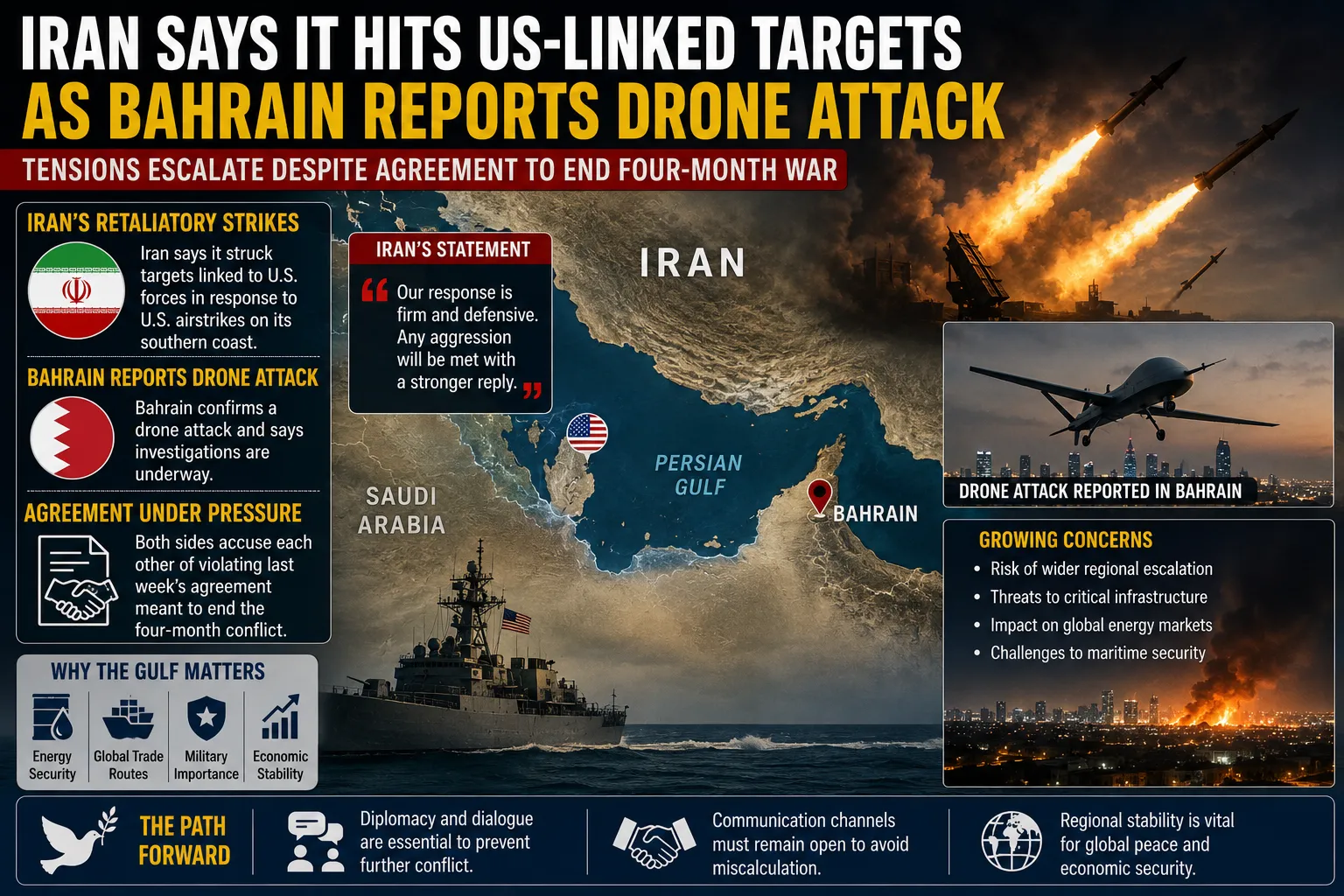
Why the Gulf Region Matters Globally
The Persian Gulf remains one of the world's most strategically important regions.
Several factors explain its global significance:
Energy Security
The Gulf region contains some of the world's largest oil and natural gas reserves. Any disruption in the area can affect global energy markets and influence fuel prices worldwide.
International Shipping Routes
The region's maritime routes are among the busiest and most strategically significant trade corridors on earth. A large portion of global energy shipments passes through nearby waterways.
Military Importance
Several countries maintain military facilities and security partnerships across the Gulf. As a result, regional tensions often carry international consequences.
Economic Stability
Uncertainty in the Gulf can influence global financial markets, investor confidence, and international trade patterns.
Because of these factors, developments involving Iran and the United States are closely monitored by governments, businesses, and international organizations around the world.
The Growing Role of Drones in Modern Conflicts
The reported drone attack in Bahrain highlights how warfare has evolved in recent years.
Unmanned aerial systems have increasingly become important instruments in regional conflicts because they offer several strategic advantages:
-
Lower operational costs
-
Ability to strike targets remotely
-
Reduced risk to military personnel
-
Flexibility in targeting infrastructure
-
Potential for psychological impact
However, drones also create significant security challenges.
Their increasing use has complicated traditional defense planning and introduced new risks for both military installations and civilian infrastructure.
Countries throughout the Middle East have significantly increased investments in air defense systems and surveillance technologies to address these emerging threats.
The Challenge of Preventing Escalation
One of the primary concerns following the latest incidents is the possibility of further escalation.
Military exchanges often carry the risk of unintended consequences. Actions intended as limited retaliation can trigger additional responses, creating cycles of confrontation that become increasingly difficult to control.
International relations experts frequently warn that periods of heightened tension require careful diplomatic management and continuous communication between all parties involved.
Even relatively small incidents can rapidly acquire broader strategic significance when they occur in highly sensitive regions.
Preventing misunderstandings and avoiding miscalculations therefore becomes a critical priority.
Diplomatic Efforts Face Major Obstacles
Diplomatic solutions remain the preferred approach for managing tensions between Iran and the United States.
However, achieving lasting progress presents considerable challenges.
Several issues continue to complicate negotiations:
-
Deep political mistrust
-
Conflicting security priorities
-
Regional rivalries
-
Differing interpretations of previous agreements
-
Concerns regarding military activities and alliances
Despite these difficulties, diplomatic engagement remains essential because military solutions alone rarely provide durable stability.
International organizations and regional partners often encourage dialogue precisely because prolonged confrontation carries enormous risks for all parties involved.
Impact on Regional Security
The renewed tensions are likely to influence security calculations throughout the Middle East.
Neighboring countries often face difficult choices during periods of heightened confrontation between major regional actors.
Governments may increase security measures, strengthen border surveillance, and review contingency plans designed to protect critical infrastructure and essential services.
The possibility of attacks on transportation networks, energy facilities, and strategic assets remains a significant concern whenever regional tensions intensify.
Consequently, the latest developments are likely to prompt renewed discussions regarding collective security arrangements and crisis management mechanisms in the Gulf.
Economic Implications of Rising Tensions
Geopolitical instability frequently produces economic consequences that extend far beyond the immediate area of conflict.
Markets generally react cautiously to developments that could threaten energy supplies or disrupt international trade routes.
Periods of uncertainty can influence:
-
Oil and gas prices
-
Investment decisions
-
Shipping costs
-
Insurance premiums
-
Currency movements
-
Business confidence
Although markets often adapt quickly to temporary disruptions, prolonged instability can create wider economic challenges.
This explains why governments and financial institutions closely monitor geopolitical developments in the Gulf region.
The Importance of Dialogue and De-Escalation
The latest confrontation serves as another reminder of how quickly tensions can re-emerge even after agreements aimed at reducing hostilities.
Sustainable peace requires more than temporary understandings. It demands mechanisms for communication, conflict resolution, and confidence-building among parties that often hold deeply opposing perspectives.
Diplomatic channels become particularly important during periods of heightened military activity because they provide opportunities to clarify intentions, address grievances, and prevent further escalation.
The international community generally supports de-escalation efforts because the costs of prolonged conflict are likely to be borne not only by the directly involved parties but also by the broader region and global economy.
Conclusion
Iran's announcement that it struck targets linked to U.S. forces and Bahrain's report of a drone attack have once again placed the Middle East at the center of international attention. The incidents occurred despite an agreement intended to reduce tensions and end months of confrontation, underscoring the fragility of diplomatic understandings in an environment marked by deep mistrust and competing security concerns.
The developments highlight the interconnected nature of modern geopolitics, where military actions, regional alliances, economic interests, and technological advancements such as drone warfare increasingly shape international relations. As both Iran and the United States continue to accuse each other of violating recent commitments, the immediate challenge for all parties will be preventing further escalation and preserving opportunities for diplomatic engagement. The coming days will be critical in determining whether tensions can be contained or whether the region enters another period of prolonged instability.
roystonhotel roystonhotel roystonhotel roystonhotel roystonhotel roystonhotel roystonhotel roystonhotel roystonhotel roystonhotel roystonhotel roystonhotel roystonhotel roystonhotel roystonhotel roystonhotel roystonhotel roystonhotel roystonhotel roystonhotel roystonhotel roystonhotel roystonhotel roystonhotel roystonhotel roystonhotel roystonhotel roystonhotel roystonhotel roystonhotel roystonhotel roystonhotel roystonhotel roystonhotel roystonhotel roystonhotel roystonhotel roystonhotel roystonhotel roystonhotel roystonhotel roystonhotel roystonhotel roystonhotel roystonhotel roystonhotel roystonhotel roystonhotel roystonhotel roystonhotel roystonhotel roystonhotel roystonhotel roystonhotel roystonhotel roystonhotel roystonhotel roystonhotel roystonhotel roystonhotel roystonhotel roystonhotel roystonhotel roystonhotel roystonhotel roystonhotel roystonhotel roystonhotel roystonhotel roystonhotel roystonhotel roystonhotel roystonhotel roystonhotel roystonhotel roystonhotel roystonhotel roystonhotel roystonhotel roystonhotel roystonhotel roystonhotel roystonhotel roystonhotel roystonhotel roystonhotel roystonhotel roystonhotel roystonhotel roystonhotel roystonhotel roystonhotel roystonhotel roystonhotel roystonhotel roystonhotel roystonhotel roystonhotel roystonhotel roystonhotel roystonhotel roystonhotel roystonhotel roystonhotel roystonhotel roystonhotel roystonhotel roystonhotel roystonhotel roystonhotel roystonhotel roystonhotel roystonhotel roystonhotel roystonhotel roystonhotel roystonhotel roystonhotel roystonhotel roystonhotel roystonhotel roystonhotel roystonhotel roystonhotel roystonhotel roystonhotel roystonhotel roystonhotel roystonhotel roystonhotel roystonhotel roystonhotel roystonhotel roystonhotel roystonhotel roystonhotel roystonhotel roystonhotel roystonhotel roystonhotel roystonhotel roystonhotel roystonhotel roystonhotel roystonhotel roystonhotel roystonhotel roystonhotel roystonhotel roystonhotel roystonhotel roystonhotel roystonhotel roystonhotel roystonhotel roystonhotel roystonhotel roystonhotel roystonhotel roystonhotel roystonhotel roystonhotel roystonhotel roystonhotel roystonhotel roystonhotel roystonhotel
