
In India’s charged political landscape, sharp rhetoric and legal battles often intersect, reflecting both the vibrancy and volatility of democratic discourse.
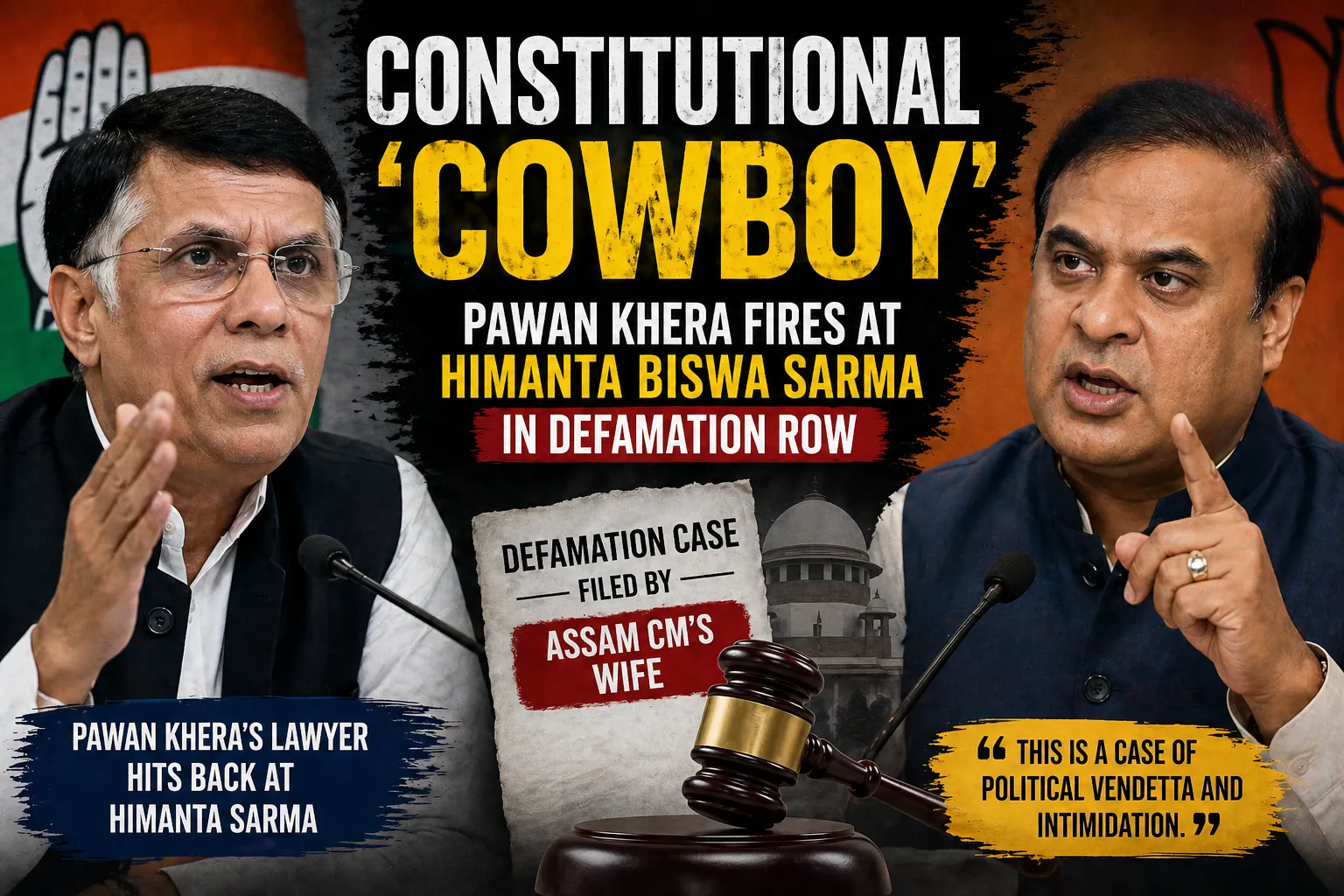
The recent defamation dispute involving Pawan Khera and Himanta Biswa Sarma has once again brought into focus the delicate balance between freedom of expression and the right to reputation. The phrase “constitutional cowboy,” used during the exchange, has become a flashpoint—symbolizing the broader tensions between political speech, personal allegations, and legal accountability.
The Context of the Dispute
The controversy stems from remarks made by Pawan Khera, a prominent spokesperson of the Indian National Congress, regarding the family of Himanta Biswa Sarma. The comments triggered a legal response, with a defamation case reportedly filed by Sarma’s wife. This development transformed what might have remained a political spat into a formal legal confrontation.
Defamation cases in India often arise in politically sensitive contexts, particularly when statements are perceived to cross the line from criticism into personal or reputational harm. In this instance, the involvement of a family member adds an additional layer of complexity, shifting the focus from political disagreement to alleged personal defamation.
The “Constitutional Cowboy” Remark
The phrase “constitutional cowboy,” used by Khera’s legal representation in response to the proceedings, has attracted widespread attention. While rhetorically striking, it raises important questions about the tone and limits of political and legal discourse.
Such language reflects a broader trend in Indian politics, where sharp, often provocative expressions are used to capture public attention and frame narratives. However, when such remarks enter legal proceedings, they can influence both public perception and the tone of the case itself.
The use of metaphorical language—particularly one that implies disregard for norms or authority—can be interpreted in multiple ways. Supporters may view it as a legitimate critique, while opponents may see it as disrespectful or defamatory.
Defamation Law in India: A Brief Overview
To understand the implications of the case, it is essential to consider the legal framework governing defamation in India. Defamation can be both a civil and criminal offense under Indian law.
-
Civil defamation involves seeking damages for harm caused to reputation.
-
Criminal defamation, under the Indian Penal Code, can lead to fines or imprisonment.
For a statement to be considered defamatory, it must be shown that it was made with the intention to harm, or with knowledge that it could harm, a person’s reputation.
However, the law also provides defenses, including truth (if it serves public interest), fair comment, and statements made in good faith. Political speech often operates within these grey areas, making defamation cases particularly complex.
Freedom of Speech vs. Right to Reputation
The Khera–Sarma dispute highlights a fundamental tension in democratic societies: the balance between freedom of speech and the right to reputation.
India’s Constitution guarantees freedom of speech and expression under Article 19(1)(a). However, this right is not absolute. Reasonable restrictions can be imposed in the interest of public order, decency, and defamation.
Political leaders and spokespersons frequently push the boundaries of this freedom, especially during high-stakes debates. While robust criticism is a cornerstone of democracy, personal allegations—particularly those involving private individuals—are subject to stricter scrutiny.
The Role of Political Communication
Modern political communication is shaped by 24/7 news cycles, social media amplification, and intense public scrutiny. In such an environment, statements are often crafted not only to convey a message but also to generate impact.
Pawan Khera, known for his articulate and often sharp critiques, represents a style of political communication that blends legal awareness with rhetorical flair. On the other hand, Himanta Biswa Sarma, a prominent political figure with a strong regional and national presence, has consistently defended his position against criticism.
The clash between these two figures reflects broader political dynamics, where narratives are contested both in public forums and in courts of law.
Legal Strategy and Public Perception
Defamation cases involving political figures are rarely confined to the courtroom. They play out simultaneously in the media and public discourse, shaping perceptions on both sides.
For the complainant, filing a defamation case can serve as a means to protect reputation and signal intolerance for alleged misinformation. For the accused, the defense often involves asserting the right to free speech and framing the case as an attempt to suppress criticism.
The “constitutional cowboy” remark can be seen as part of this broader strategy—positioning the legal battle within a narrative of constitutional values and political accountability.
The Involvement of Family Members
One of the distinguishing aspects of this case is the involvement of the Chief Minister’s wife as the complainant. This shifts the focus from political critique to alleged personal defamation.
Indian courts have historically taken a serious view of statements that target private individuals, especially when they are not directly involved in public life. This raises the stakes for the defense, as the threshold for justifying such statements becomes higher.
At the same time, the case also prompts discussion about the boundaries of political accountability and whether public figures’ families should be considered off-limits in political discourse.
Broader Implications for Political Discourse
The Khera–Sarma defamation row is not an isolated incident. It reflects a broader pattern in Indian politics, where legal mechanisms are increasingly used to address disputes arising from public statements.
This trend has both positive and negative implications:
Positive Aspects:
-
Encourages accountability in public speech
-
Provides legal recourse for reputational harm
-
Reinforces the importance of factual accuracy
Challenges:
-
Risk of legal action being used to stifle criticism
-
Prolonged legal battles that distract from governance
-
Escalation of political tensions
The Judiciary’s Role
Ultimately, it is the judiciary that must navigate these complex issues, balancing competing rights and interpreting the nuances of each case.
Courts often emphasize the importance of context, intent, and the nature of the statements in question. In politically sensitive cases, judgments can have far-reaching implications for how freedom of speech is exercised in the future.
The outcome of this dispute, therefore, may contribute to evolving legal standards regarding political speech and defamation.
Conclusion
The defamation row involving Pawan Khera and Himanta Biswa Sarma underscores the intricate relationship between politics, law, and public discourse in India.
The phrase “constitutional cowboy” may have captured headlines, but the underlying issues extend far beyond a single remark. They touch upon fundamental questions about the limits of political expression, the protection of individual reputation, and the role of the judiciary in maintaining this balance.
As the case unfolds, it serves as a reminder that in a society, the power of words carries both influence and responsibility. Political leaders, legal professionals, and citizens alike must navigate this space with awareness, ensuring that the pursuit of debate does not come at the cost of dignity and fairness.
In an era where every statement can be amplified instantly, the intersection of law and rhetoric will continue to shape the contours of India’s democratic conversation.
quorvel.shop quorvel.shop quorvel.shop quorvel.shop quorvel.shop quorvel.shop quorvel.shop quorvel.shop quorvel.shop quorvel.shop quorvel.shop quorvel.shop quorvel.shop quorvel.shop quorvel.shop quorvel.shop quorvel.shop quorvel.shop quorvel.shop quorvel.shop quorvel.shop quorvel.shop quorvel.shop quorvel.shop quorvel.shop quorvel.shop quorvel.shop quorvel.shop quorvel.shop quorvel.shop quorvel.shop quorvel.shop quorvel.shop quorvel.shop quorvel.shop quorvel.shop quorvel.shop quorvel.shop quorvel.shop quorvel.shop quorvel.shop quorvel.shop quorvel.shop quorvel.shop quorvel.shop quorvel.shop quorvel.shop quorvel.shop quorvel.shop quorvel.shop quorvel.shop quorvel.shop quorvel.shop quorvel.shop quorvel.shop quorvel.shop quorvel.shop quorvel.shop quorvel.shop quorvel.shop quorvel.shop quorvel.shop quorvel.shop quorvel.shop quorvel.shop quorvel.shop quorvel.shop quorvel.shop quorvel.shop quorvel.shop quorvel.shop quorvel.shop quorvel.shop quorvel.shop quorvel.shop quorvel.shop quorvel.shop quorvel.shop quorvel.shop quorvel.shop quorvel.shop quorvel.shop quorvel.shop quorvel.shop quorvel.shop quorvel.shop quorvel.shop quorvel.shop quorvel.shop quorvel.shop quorvel.shop quorvel.shop quorvel.shop quorvel.shop quorvel.shop quorvel.shop quorvel.shop quorvel.shop quorvel.shop quorvel.shop quorvel.shop quorvel.shop quorvel.shop quorvel.shop quorvel.shop quorvel.shop quorvel.shop quorvel.shop quorvel.shop quorvel.shop quorvel.shop quorvel.shop quorvel.shop quorvel.shop quorvel.shop quorvel.shop quorvel.shop quorvel.shop quorvel.shop quorvel.shop quorvel.shop quorvel.shop quorvel.shop quorvel.shop quorvel.shop quorvel.shop quorvel.shop quorvel.shop quorvel.shop quorvel.shop quorvel.shop quorvel.shop quorvel.shop quorvel.shop quorvel.shop quorvel.shop quorvel.shop quorvel.shop quorvel.shop quorvel.shop quorvel.shop quorvel.shop quorvel.shop quorvel.shop quorvel.shop quorvel.shop quorvel.shop quorvel.shop quorvel.shop quorvel.shop quorvel.shop quorvel.shop quorvel.shop quorvel.shop quorvel.shop quorvel.shop quorvel.shop quorvel.shop quorvel.shop quorvel.shop quorvel.shop quorvel.shop quorvel.shop quorvel.shop quorvel.shop quorvel.shop quorvel.shop
infinityinspires.com codecraftes.com linklaunches.com pixelperkes.com quantumquestes.com sunshinstates.com techsthrive.com webeswhiz.com webswisdoms.com
